Begging is nothing new in human history. The oldest recorded mentioning about begging is 4’500 years old. On an ancient fragment of papyrus found in Egypt, a vizier with the name Kagemni wrote:
A king and a beggar are the same.
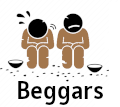
Begging is ancient and will most likely always be with us. But it can be managed better. In this section we explain the reasons why some people beg, the ways in which people beg, and not to fall into the trap of toxic charity.
Why do people beg?
People beg because of different reasons:
- Economic reasons
Falling into hardship by being born on poverty, being unemployed or losing a job, homeless, lack of skills, and other… - Personal problems
Addiction, disability, mental illness, bad childhood experiences, broken family, and other… - Not interested in joining society
Some beggars are just not interested in being members of a community and would rather exploit your goodness. - Professional beggars
Begging is their “job”. They often beg just enough to buy food and booze, and then linger around the remainder of the day. They are not interested in getting a job. - Forced begging
Some irresponsible parents, or a gang, may force someone to beg on their behalf – thus acting like pimps. Unfortunately in Tulbagh some alcoholic parents force their children to beg money for their drinks. There have also been cases where young children are forced to beg for their pimp’s drug money.
It is clear that due to the different circumstances of different individual beggars, there is no single solution that applies to all. Individual circumstances need to be understood before useful assistance can be given.
Beggar behaviours
Beggars have different strategies to get something from you. Here is a brief list of different ways of begging.
- Performing Beggars
The have some performance and expect you pay them for their act. Some do tricks, play music, use some animal that does tricks, and so on - Storytellers
Some story tellers entertain. There was a time when bergies entertained patrons at the hotel on Greenmarket Square in Cape Town.
Some story tellers have a long sad story to play on your emotions with the hope of extorting money from you. They usually forget that they have already approached you, and on a later occasion they will confront you with the same sad story. - Passive beggars
The sit or stand with something in which you can put money, not asking for anything. They might sold you if you put a sandwich in their hat – a clear indication they’re not hungry.
They often add a religious action, pretending to pray in a prostrating manner in order to soften your heart. - Forcing Service Beggars
Without asking you they would start doing something, such as washing your windscreen or car, or polishing shoes and son on and of course expecting payment. - Peddlar beggars
They would appear at your restaurant table or (other places) trying to sell you flowers, balloons and what not – carnations or roses on Valentine’s evening. - Aggressive beggars
They take an aggressive stance trying to intimidate you to give them something. If you don’t, they might scratch your car or even slash your car tyres.
Also see Ahamdi’s article in Sociology; and
Rasool and Kausar, Psychosocial Causes of Beggary
Toxic charity
There are loads of good humans who have empathy with beggars. There are also unfortunately a load of beggars who just know how to play on your good hearts to get something from you.
Your goodness often creates a toxic cycle of continuous begging where initially the beggar is grateful for your gift or donation, but later demands it. Here is what research found:
- Stage 1: Appreciation
When you first help beggars, they might be thankful - Stage 2: Anticipation
Once you have donated to a beggar, he/she anticipates next time you will give again - Stage 3: Expectation
Once you have given three times, the expectation will continue - Stage 4: Entitlement
By now the recipient feels entitled to your goodwill - Stage 5: Dependency
And finally the beggar does not take responsibility for his/her own life and will continue to depend on your goodwill
Also see https://www.truecharity.us/
Stop creating dependency
To not entrap a beggar in an endless cycle of dependency, we need to create other opportunities for the really needy and hungry.
To limit the need to beg because of hunger, our goal is to serve at least a good meal every day of the week. There is thus no reason for a hungry person to beg for food.
But…

Give someone a fish. Tomorrow they want another
Teach someone to fish, and they become self-sufficient
Don’t fall for the trap of “I’m-telling-a-story-to-feel-sorry-for-me” card that some seasoned beggars use to manipulate your good heart. By giving to such con artists you prevent your donations from reaching someone who really needs support. Give responsibly.
Break the toxic cycle
Give responsibly

Join and support us…
Donate to Pantry Partners and we’ll not only serve meals to the hungry.
We will get them involved in programs to develop their self-image and capabilities.
And assist to reintegrate them back into society as responsible members.